PRELIM TASK
The 180 degree rule is essential in keeping the viewer focused and avoiding confusion. once a scene has been recognized, the camera must stay on one side of the action.
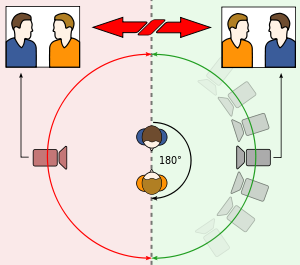 If
two people are facing each other, a line must be drawn. This line usually runs
straight down the middle between the two people, like so: Once this line is in
place, the camera can move anywhere providing it stays on the same side of the
line once filming has begun. If the camera is switching between two faces
during a conversation for example and then suddenly cuts to the other side of
the line, then it will appear that both people are facing the same direction
instead of looking at each other. Match on action is a very simple but
essential technique, where the perspective of the camera changes during a scene
and the scene continues to flow. A good example of 'Match on action' is between
2 and 3 seconds. As you can see, the perspective changes while the scene still
flows without any disruption.
If
two people are facing each other, a line must be drawn. This line usually runs
straight down the middle between the two people, like so: Once this line is in
place, the camera can move anywhere providing it stays on the same side of the
line once filming has begun. If the camera is switching between two faces
during a conversation for example and then suddenly cuts to the other side of
the line, then it will appear that both people are facing the same direction
instead of looking at each other. Match on action is a very simple but
essential technique, where the perspective of the camera changes during a scene
and the scene continues to flow. A good example of 'Match on action' is between
2 and 3 seconds. As you can see, the perspective changes while the scene still
flows without any disruption.
Eye
Line match is where a shot is taken off a person looking at someone and in the
next the other character is looking back at the first character. The eye line
is match is very important as if it doesn't look like the two characters are
looking at each other it will seem less realistic and make the audience feel
like the film/video is of a low quality and once again distort the continuity
of the video.
It
relates to shot reverse shot and the 180° rule as if those aren't used properly
then the eye line match can not be taken out correctly as the characters will
be looking in opposite directions.
When
creating our own work, we tried to include the the following rules to make our
own more successful. We incorporated the match on action angle when the actor
would hand over the detonator to the other subject. i think the helped the scene flow, from this different environment. we performed this smoothly which worked to our advantage as we had less glitches and looked slightly more professional.
in the terms of filming we found it quiet easy to follow the story board as we had two enthusiastic actor who corporated smoothly with us making the process easier, however i found it hard to deal with the general public as they created noise population, so we had to move location and film in a quieter destination. we did also notice that when following the storyboard we missed off some camera angles, in order to improve next time we should double check the story board to confirm our actions.
this process has educated me alot about ususingdobe premire pro, i only had a little knowledge beforehand by watching tutorials. However with hands on hands action it was much easier to get to know the different tools and how to use them effectively i preferred this approach as it was much easier learning while editing. I definatly feel more confident for the future when it comes to editing our own creations .
this process has educated me alot about ususingdobe premire pro, i only had a little knowledge beforehand by watching tutorials. However with hands on hands action it was much easier to get to know the different tools and how to use them effectively i preferred this approach as it was much easier learning while editing. I definatly feel more confident for the future when it comes to editing our own creations .
